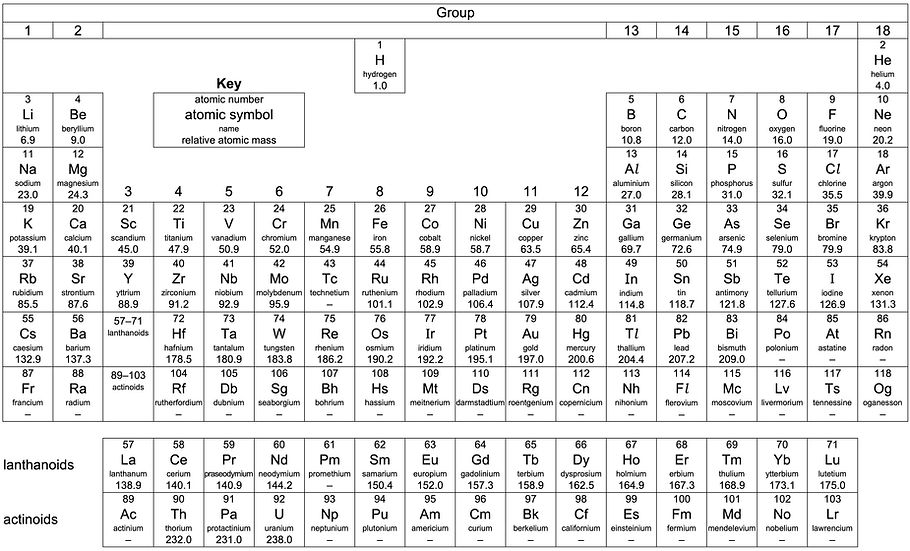
A Level Chemistry Data Booklet 2026 for H1, H2 and H3
The A Level Chemistry Data Booklet is issued by Cambridge Assessment International Education and is provided to students in all H1, H2 and H3 Chemistry papers, with the exception of practical examinations.
The booklet contains essential chemical data, including physical constants, ionisation energies, bond energies, standard electrode potentials, atomic and ionic radii, spectroscopic data, and the Periodic Table, that students are expected to reference and apply during their examinations, rather than memorise.
This page reproduces the full contents of the data booklet in a web-friendly format, with a clickable menu for quick navigation to each section. Reproduced for educational reference.
Contents: Tables of Chemical data
1. Important values, constants and standards
2. Ionisation energies (1st, 2nd, 3rd and 4th) of selected elements, in kJ mol⁻¹
4. Standard electrode potential and redox potentials, Eθ at 298 K (25 °C)
6. Typical proton (¹H) chemical shift values (δ) relative to TMS = 0
7. Characteristic infra-red absorption frequencies for some selected bonds
8. The orientating effect of groups in aromatic substitution reactions
1. Important values, constants and standards

This first table brings together the physical constants used throughout H2 Chemistry:
-
Molar gas constant – Gas law calculations, pV = nRT
-
Faraday constant – Electrochemistry, Q = n(e) x F = I x t
-
Avogadro constant – Mole calculations and particle counting, F = Le
-
Rest masses and charges – used in atomic structure and mass spectrometry questions
-
Molar volumes – Mole calculations for gases
-
Ionic product of water – Acid-base equilibria and pH calculations, Kw = [H+][OH–]
-
Specific heat capacity of water – Energetics, q = mcΔT
Rather than memorising these values, students are expected to look them up here and substitute them directly into their working, so it's worth knowing where each one sits before exam day.
2. Ionisation energies (1st, 2nd, 3rd and 4th) of selected elements, in kJ mol⁻¹


This table lists the first four ionisation energies for a range of elements. These numbers are usually quoted for Energetics questions where "Use of the Data Booklet is relevant", in particular when drawing Born-Haber cycles and calculating the lattice energies of ionic compounds.
3. Bond energies
3(a) Bond energies in diatomic molecules (these are exact values)

3(b) Bond energies in polyatomic molecules (these are average values)

Bond energies are often used to estimate enthalpy changes when a direct experimental value is not available:
ΔH = Σ(bonds broken) − Σ(bonds formed)
Important assumptions:
-
Bond energies are measured in the gaseous state.
-
Diatomic values in Table 3(a) are exact, measured directly for that specific bond. Polyatomic values in Table 3(b) are average values of bond dissociation energies (BDE) taken across many different molecules containing that bond, so an enthalpy change calculated using values from 3(b) is always an estimate.
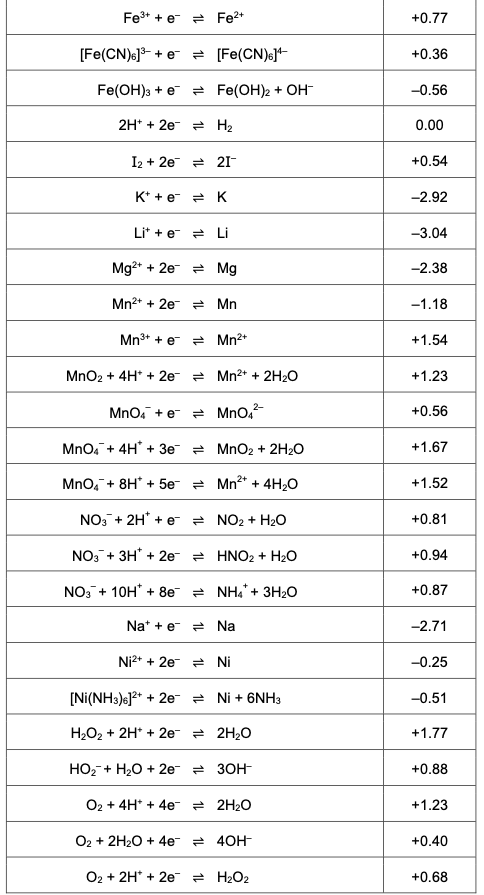
4. Standard electrode potential and redox potentials, Eθ at 298 K (25 °C)
For ease of reference, two tabulations are given:
(a) an extended list in alphabetical order;
(b) a shorter list in decreasing order of magnitude, i.e. a redox series.
All ionic states refer to aqueous ions but other state symbols have been omitted.
4(a) Eθ in alphabetical order


4(b) E⦵ in decreasing order of oxidising power
(a selection only – see also the extended alphabetical list on the previous pages)


Electrode potentials support two related skills:
-
predicting whether a redox reaction will proceed, and
-
comparing how strong different oxidising and reducing agents are.
A more positive E° value indicates a stronger oxidising agent.
A more negative E° value indicates a stronger reducing agent.
A thermodynamically feasibly reaction occurs when the electrode cell potential is calculated to be positive:
E°cell = E°(reduction) − E°(oxidation)
Table 4(a) is arranged alphabetically to facilitate easy look-up of a specific known half-equation.
Table 4(b) is ordered by decreasing oxidising power, and is used for scanning to see which species will act as the oxidising agent and which as the reducing agent, since a higher-up species is the stronger oxidising agent.
The same values also underpin preferential discharge at the electrodes during electrolysis.
5. Atomic and ionic radii


The syllabus requires the ability to
-
describe and explain the trend of atomic radii across Period 3, the transition elements, as well as down a group, and
-
describe and explain the trend of ionic radii across Period 3.
This table gives actual atomic and ionic radii values rather than expecting you to derive them from trend alone.
The explanation is based on the trends of effective nuclear charge, as determined by nuclear charge and shielding effect:
Zeff = Z – S
6. Typical proton (¹H) chemical shift values (δ) relative to TMS = 0
Note: δ values for ―O―H and ―N―H protons can vary depending on solvent and concentration.

This table is used in structure elucidation questions: given the chemical shifts observed in a ¹H NMR spectrum, match each value against this table to identify what type of proton produced it, then piece the fragments together into a full structure.
Note: this table is H3 Additional Content — not examined at H2.
7. Characteristic infra-red absorption frequencies for some selected bonds

IR spectroscopy detects which functional groups are present by matching absorption peaks in the spectrum to bond types in this table, rather than giving positional or connectivity information the way NMR does. It's most often used as the first step in structure elucidation: narrowing down which functional groups a compound contains before the ¹H NMR data is brought in to work out how those groups are arranged.
Note: this table is H3 Additional Content — not examined at H2.
8. The orientating effect of groups in aromatic substitution reactions

This table tells you
-
where the next substituent will attack an already-substituted (G) benzene ring, either 2,4-positions or 3-positions, and
-
whether the existing substituent (G) activates or deactivates the benzene ring toward the attacking electrophile.
Be able to explain the activating / deactivating effects through electron donating / withdrawing inductive and delocalisation effects.
9. Qualitative Analysis Notes
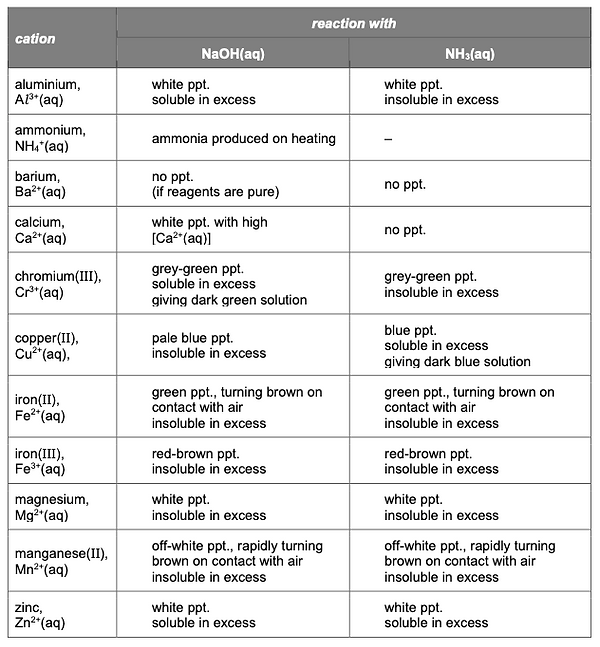
9(a) Reactions of aqueous cations
9(b) Reactions of anions

9(c) Tests for gases

9(d) Colour of halogens

These tables are primarily meant for the practical Paper 4. The four subsections work together as one identification workflow: cation tests and anion tests narrow down the ionic composition of an unknown salt, gas tests confirm what's been evolved during a reaction, and halogen colours are used to identify a diatomic halogen or verify a displacement reaction.
It is important to match each observation in the tables with theoretical equations and concepts from the Inorganic Chemistry portion of the syllabus: Periodic 3, Groups 2 and 17, and Transition Elements.